Showing posts with label energy efficent. Show all posts

Tuesday, October 19, 2010

How “Going Green” with Building & Maintenance can Put Your Company in the Black

Last Friday Examiner.com posted an interesting article on the advantages of going green. An article from the RDTC Tax Help Blog was even quoted towards the end of the article, for a post from earlier in the year that explained the tax advantages of going green in 2010. You can find a section of the Examiner.com article below, or click here for the full text.

Improved customer image

Customers are influenced in their purchasing decisions by whether a business shows environmental consciousness. For instance, Environmental Leader reported in 2007 that 72 percent of rental customers wanted hybrid vehicles included among rental car options, according to a survey conducted by Priceline.com. Nearly half of all cell phone customers consider a mobile carrier provider's "green" credentials, according to a 2009 ABI Research report cited by Green Electronics Daily. In a tough housing market, 70 percent of potential home buyers were more inclined to purchase homes with "green" features, according to LOHAS Online, (Lifestyles of Health and Sustainability) quoting the 2008 Green SmartMarket Report from McGraw-Hill Construction Analytics entitled "The Green Home Consumer: Driving Demand for Green Homes." Customers also and tend to remain loyal to "green" companies during economic downturns, MoreBusiness.com claims.

Enhanced worker productivity

The U.S. Environmental Protection Agency (EPA) defines "sick building syndrome" to refer to health-related complaints by workers that cannot be attributed to a particular cause. A similar condition, "building related illness," applies to health-related complaints directly related to airborne contaminants. Symptoms of "sick building syndrome" and "building related illness" include respiratory distress, headache, fatigue and dizziness, according to the EPA. A survey of 100 office workers revealed that 23 percent suffered symptoms related to "sick building syndrome," according to the New York Real Estate Journal, citing research from the ASHRAE Journal (American Society of Heating, Refrigerating, and Air-Conditioning Engineers).

The nationwide cost in lost productivity related to "sick building syndrome" amounts to 2 percent annually, according to New York Real Estate Journal. Increasing indoor ventilation and reducing the indoor concentration of carbon dioxide to meet the standards established by LEED V3 (Leadership in Energy and Environmental Design), diminishes complaints related to "sick building syndrome," claims Just Venting, citing research conducted by Lawrence Berkeley National Laboratory in California. LEED V3 standards for indoor ventilation call for a 30 percent increase above the 2007 ASHRAE 62.1 ventilation standard of 20 cubic feet per minute (CFM) per person. Substituting nontoxic building materials, cleaning supplies and office equipment that do not emit volatile organic compounds (VOCs) greatly reduces airborne contaminants related to "building related illness."

Monday, April 26, 2010

Questions for the Tax Lady: April 26th, 2010

Check out the following new Questions for the Tax Lady answers and feel free to ask me questions through one of the links below. You can send me an email, direct message or @ reply, and I will do my best to get an answer for you!


Question #1: If I make energy efficient upgrades to a rental property will they still qualify for the federal tax credit?

Unfortunately, the IRS will only allow you to claim the federal tax credit for energy efficient improvements made to your primary residence. Therefore, rental properties or summer homes will generally not qualify.

Question #2: I just realized I made a mistake on my federal tax return, how do I correct it?

You may need to file an amended return with the IRS depending on the error. If it is just a simple math error then the IRS will most likely correct it, but if you forgot to include all sources of income or missed a valuable credit then you will need for file IRS Form 1040X, Amended U.S. Individual Income Tax Return.

Thursday, April 22, 2010

Happy Earth Day!


Earth Day is a great reminder to go green and reduce our carbon footprints. As I have explained before, there are plenty of tax incentives to live a more energy efficient lifestyle. A few weeks ago, the RDTC Tax Help Blog posted a blog entry explaining some of the tax advantages of going green in 2010. Check out the article, and think about what you can do to help the planet today in honor of Earth Day! I give thanks to Sacramento Scoop.com for the above graphic.

Tuesday, February 16, 2010

'Cash For Appliances' Coming to a State Near You

The Government’s $300 million ‘Cash for Appliances’ program first introduced through the American Recovery and Reinvestment Act has started to go into effect in some states. According to CNN Money.com, it will allow taxpayers to receive rebates for purchasing qualifying energy efficient appliances. The program was designed to act similarly to the recently successful Cash for Caulkers and Cash for Clunkers incentives from last year.

Under the program, consumers are eligible to receive rebates on new, energy-efficient appliances such as refrigerators or washing machines. The rebates vary by state, type of appliance, and level of efficiency.

Rebates are only available on appliances with the Energy Star logo, which meet the energy efficiency guidelines set by the Environmental Protection Agency and Department of Energy.

The goal of Cash for Appliances is to help American's conserve energy, while also boosting retail sales and ultimately helping spur the economic recovery.

In New York, where the program went into effect Friday, rebates range from $75 to $105 on refrigerators, freezers and clothes washers. The rebates can be as high as $555 for bundled purchases of all three appliances.

Continue reading at CNN Money.com…

Thursday, December 10, 2009

Obama Proposes Homeowner “Cash for Caulkers” Program

According to Bloomberg.com, President Obama has proposed a new incentive for homeowners modeled after the highly “Cash for Clunkers” program. Humorously referred to as “Cash for Caulkers,” the legislation would provide incentive for taxpayers to make energy efficient improvements to their homes. In addition to helping homeowners, the program is expected to create new jobs by stimulating companies like Dow Chemical Co. and retailers Home Depot and Lowe’s.

“The president’s proposals on weatherization and industrial energy efficiency will have the triple benefit of creating jobs quickly, saving consumers money and reducing our nation’s carbon footprint,” Plishka said in a statement.

Rebates for residences that are made more energy-efficient were proposed by Obama in a speech yesterday calling for new spending to cut the U.S. jobless rate. Lawmakers and business executives suggested the project, and the term “cash for caulkers,” as a way to replicate this year’s “cash for clunkers” auto rebate program.

“I’m calling on Congress to consider a new program to provide incentives for consumers who retrofit their homes to become more energy-efficient, which we know creates jobs, saves money for families and reduces the pollution that threatens our environment,” Obama said at the Brookings Institution in Washington.

The president didn’t use the program’s nickname or provide specifics, such as the amount of the rebates or cost. It would have to be approved by Congress.

“This kind of energy program will help homeowners gain back some of the value they may have lost over the past few years,” Chris Ahearn, a spokeswoman for Mooresville, North Carolina-based Lowe’s, said in a phone interview yesterday. “It will also help contractors who want to get back to work or add work.”

Thursday, August 27, 2009

Cities Turn Off Streetlights to Save Money

USA Today posted a great article on the recession’s latest victim: the streetlight. Although turning off a few lights might seem like no bid deal, as the article explains, it can actually save local government agencies thousands of dollars per month. Some cities are even considering a new “streetlight fee” that could be added to resident’s local tax bills.

The cost-cutting moves coincide with changing attitudes about streetlights. Once viewed as helpful safety measures, the lights are increasingly seen by some public officials and researchers as an environmental issue, creating light pollution and burning excess energy.

In July, Santa Rosa, Calif., started a two-year effort to remove 6,000 of the city's 15,000 streetlights. An additional 3,000 will be placed on a timer that shuts lights off from midnight to 5:30 a.m. Savings: $400,000 a year.

The city boasts that it will cut its carbon footprint. What really matters, though, is money.

Public works director Rick Moshier says he'd already cut his department's budget by 25% when he turned to streetlights. "I can either fix potholes and storm drains or keep paying $800,000 a year for electricity," Moshier says.

Turning out the lights has met some local resistance. Santa Rosa has a hotline for complaints.

"What about the human factor?" says Kenneth Ozoonian of North Andover, Mass. His town is turning off 626 streetlights — about one-third of the town's total — to save $47,000 annually.

Wednesday, January 21, 2009

New Gas Tax Proposed by AutoNation CEO

Mike Jackson, CEO of AutoNation Inc., spoke to at an auto industry conference in Detroit, saying gas taxes were needed to encourage purchase of hybrid and energy efficient vehicles. A snippet of the article from Freep.com can be found below, but you can read the full text here.

The nation needs to put new tax on gasoline in place to encourage consumers to buy hybrid and electric vehicles, Mike Jackson, CEO of AutoNation Inc. said today at an automotive industry conference in Detroit.

Advertisement

Jackson said that while he recognizes that fixing the economy should take precedence for now, he thinks the nation should adopt a gas tax that would increase the price of a gallon of gas 20 cents per year for five years, eventually adding about $1 to the price of gas. The reason: The automotive industry is investing billions to develop technology to reduce the nation’s dependence on oil, but cannot recoup those costs unless they charge a premium for the vehicles.

“Consumers are not going to pay for fuel efficiency if gas is cheap,” Jackson said after speaking at Automotive News World Congress.

Ft. Lauderdale, Fla.-based AutoNation is the nation’s largest auto dealership group with 313 new vehicle franchises in 15 states.

Jackson also expressed his support for efforts to restructure the automotive industry and the dealership networks as General Motors Corp. and Chrysler restructure so that they can meet the terms of government loans.

Wednesday, August 06, 2008

8 Reasons to Buy a Hybrid

With gas prices putting a strain on everyone’s wallets, hybrid sales are soaring. But do not let the sticker price of a hybrid vehicle scare you – there are plenty of incentives to consider both before and after the purchase. Although we all probably know a handful of obvious reasons to buy a hybrid vehicle, there are actually a lot of incentives that you may have never heard of.

1. The Obvious

Gas consumption levels are much lower for hybrid vehicles (up to 50 mpg in city driving conditions). Studies show that by the 2nd or 3rd year (less if you commute or drive often) of owning the vehicle, the gas you’ve saved will have already paid for the car.

2. Future Value

Hybrid vehicles hold their value very well. After years of well-kept ownership, the value of hybrids usually only drops a few thousand dollars. This is partially because hybrids have low idle rates as their engines usually shut off at stoplights, and turn back on when you press the gas pedal again. This causes much less stress to the vehicle’s engine.

3. Maintenance

Hybrid vehicles, particularly the Toyota Prius, are made with parts that do not require much maintenance. As a Prius owner, you will only need check ups and oil changes as often as you do with normal cars.

4. Tax Incentives

Although the tax breaks have definitely decreased over time, certain tax cuts are still available to some hybrid buyers in many states. With the ongoing energy crisis, there is also growing pressure on Congress and the President to extend the old hybrid credits, or even create better ones.

5. Insurance Savings

A decent amount of insurance companies are also beginning to offer discounts for hybrid car owners. Before you buy a hybrid, call around a few different insurance companies to see if you qualify for any alternative fuel discounts.

6. Low, Manageable Leases

Major car companies, such as Toyota, have recognized the demand for hybrids is increasing and offer impressively low leases (as low as $219 a month) to help consumers who cannot afford to buy a new car.

7. Impressive Warranties

Toyota, Ford, and Honda all offer extended warranties on hybrid specific parts of their vehicles. The battery packs alone in the Toyota Prius have warranties that average out to about 12 years of use.

8. Funding a Good Cause

Buying a hybrid vehicle is one way to directly fund fuel-efficient technology. By buying and using a hybrid vehicle, you are making a statement on the ongoing energy crisis in this country.

Tuesday, January 22, 2008

7 Green Cars of the Future

With rising fossil fuel costs and global warming getting more attention in the media, environmentally friendly cars were all the rage at the Detroit Auto Show last week. At these auto shows, car manufactures usually present out-of-this world concept cars. This year, nearly every company showed off new environmentally-friendly cars.

The biggest trend at the show was new range-extended electric vehicle (REEV) concepts that run on an electric motor that powers the car 100% of the time. The vehicles plug into power outlets that charge the batteries for a 20 – 60 mile driving range. After they pass that range, a generator kicks in which recharges the batteries using any popular fuel. This includes gasoline, ethanol, or even hydrogen.

However, there were dozens of other energy efficient concept cars introduced besides REEVs. Enjoy the following list of 7 green cars of the future.

New Toyota Prius


At the Detroit auto show, Toyota's President, Katsuaki Watanabe announced that he would unveil two new hybrid models at next year’s show. One is suspected to be a Lexus hybrid, while the other is known to be the replacement for the Toyota Prius. Not much is known about what the new Prius will feature, but it is predicted to be more energy efficient with a lower price tag. Some speculate the new version could feature new plug in hybrid technology.

Volvo ReCharge


Volvo’s ReCharge concept car truly takes the phrase "green car" to the next level. Why? Because the vehicle even features green wheels. The car is a plug-in series hybrid with a battery with sufficient capacity for 62 miles of electric driving. After that, the car’s battery begins to recharge the battery. It is expected to average 124 mpg.

Chrysler ecoVoyager


Chrysler’s ecoVoyager takes the idea of plug-in hybrids to the next level. It relies on a fuel cell rather then gasoline or diesel. The vehicle features the modern "skateboard" design, which allows for a roomy cabin and low center of gravity. It weighs less than 3,000 pounds and Chrysler claims it gets a 12.9-second quarter mile. The car looks futuristic with its smooth design and vertical skylights.

Do not expect to see them on the road any time soon. Chrysler has not yet confirmed they are working on electric hybrid technology, but it certainly did not stop them from putting together an attractive concept car.

ASF Trinity Vehicles

ASF Trinity Vehicles
AFS Trinity vehicles are actually not a new brand of car, but rather a working plug-in hybrid system. The company modified a regular Saturn Vue Hybrid by adding a powerful battery capable of running 40 miles on only electric power. Trinity is one of the first companies to successfully produce a REEV and is years ahead of the major automakers.

However, the technology is still going to need improvement before it will be ready to hit the market. The system likely requires large areas of storage space for the huge batteries required to run the car. Trinity has not yet released specific pricing information.

Chevy Volt

The Volt is Chevrolet’s concept of their future REEVs. General Motors has made great strides in environmentally friendly vehicles over the past few years and plans to have the first street-ready editions on sale by late 2010. The car is expected to be able to go 40 miles on 120-kW electric motor. GM hopes to have upwards of 60,000 of the vehicles ready for its first year on the market and plans for a base price of between $30,000 and $40,000.

Opel Flextreme

Volvo Car PicturesThe Opel Flextreme is essentially a European version of the Chevy Volt. It features many of the same features as the Volt with a slightly different looking exterior. However, one major difference is that the Flextreme comes with a rear storage space specifically designed to fit a pair of Segways that can charge off the car’s batteries. Unfortunately, this extra storage space means less room for fuel, which reduces the car’s range from 640 to 444 miles.

Fisker Karma
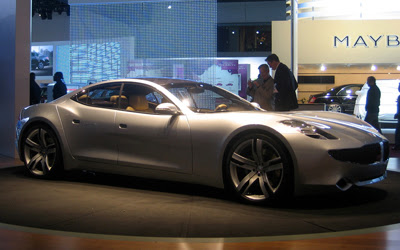
Karma pictureThe Fisker Karma represents the future of luxury sports cars. The vehicle has a sporty and attractive design but maintains maximum fuel efficiency. It features a lithium ion battery pack that can power the car for 50 miles before needing fuel. According to Fisker it can go from zero to sixty in 5.8 seconds and reach a top speed of 125 mph.

Images curtosy of AutoBlogGreen.com

Wednesday, January 02, 2008

Q&A About Ford’s Energy Efficient F450

AutoBlogGreen has an interesting Q&A session with Beau Boeckmann, the president of Galpin Auto Sports about the Ford F-450 Super Duty that runs on biodiesel and hydrogen. You can read the transcript of the interview by checking out AutoBlogGreen.


Monday, November 19, 2007

Green Car of the Year: Chevy Tahoe Hybrid

Green Car Journal founder Ron Cogan announced yesterday that this year’s Green Car of the Year Award is the Chevy Tahoe Hybrid. It received the award for demonstrating that a large vehicle with could still offer fuel economy equivalent to that of a much smaller car. Five cars were nominated for this award including the Saturn Aura Green Line, Chevy Malibu Hybrid, Nissan Altima Hybrid and Mazda Tribute Hybrid.

Blog Archive