Showing posts with label automobile. Show all posts

Tuesday, August 25, 2009

Obama Administration Extends Car Dealers' Cash for Clunkers Deadline

The popular Cash for Clunkers program gained so much momentum in its last few days, that dealerships had a hard time keeping up with the rebate-filing deadline. In response, The Department of Transportation has extended the deadline to this afternoon instead of 8 p.m. last night. The sales must have been completed by the original deadline, but dealers who were unable to submit their requests last night can do so today. Check out the following article from USA Today article about the announcement.

Department of Transportation spokeswoman Jill Zuckman said the deadline has been extended because "overwhelming demand" shut down the DOT website temporarily this afternoon.

As the Obama administration's popular auto rebate program wound into its final hours, Transportation Secretary Ray LaHood told reporters that it has been "wildly successful" in terms of jump-starting the economy.

"You've got dealers, you've got mechanics, you've got the banks doing the loans," LaHood said in Elizabethtown, Pa. "So this isn't just about the auto industry. We're talking about tons of common, ordinary people who are working today because of this program. This is such a win-win for the auto industry and for common ordinary citizens, too."

As of Monday morning, $2.58 billion worth of vouchers have been submitted and 625,000 old, polluting cars have been taken off the road in exchange for new, fuel-efficient cars, Zuckman said. Because most people turned in gas-guzzling trucks and SUVs in exchange for smaller cars, the Department of Transportation is figuring the program will mean a big decrease in pollution. The DOT says the clunkers that have been turned in were averaging 15 miles per gallon, and the new cars people got are 60% more efficient.

Monday, December 01, 2008

Autoworkers Making $70 An Hour? Not Really

From CBS News.com:

If you've been following the auto industry's crisis, then you've probably read or heard a lot about overpaid American autoworkers--in particular, the fact that the average hourly employee of the Big Three makes $70 per hour.

That's an awful lot of money. Seventy dollars an hour in wages works out to almost $150,000 a year in gross income, if you assume a forty-hour work week. Is it any wonder the Big Three are in trouble? And with autoworkers making so much, why should taxpayers--many of which make far less--finance a plan to bail them out?

Well, here's one reason: The figure is wildly misleading.

Let's start with the fact that it's not $70 per hour in wages. According to Kristin Dziczek of the Center for Automative Research--who was my primary source for the figures you are about to read--average wages for workers at Chrysler, Ford, and General Motors were just $28 per hour as of 2007. That works out to a little less than $60,000 a year in gross income--hardly outrageous, particularly when you consider the physical demands of automobile assembly work and the skills most workers must acquire over the course of their careers.

More important, and contrary to what you may have heard, the wages aren't that much bigger than what Honda, Toyota, and other foreign manufacturers pay employees in their U.S. factories. While we can't be sure precisely how much those workers make, because the companies don't make the information public, the best estimates suggests the corresponding 2007 figure for these "transplants"--as the foreign-owned factories are known--was somewhere between $20 and $26 per hour, and most likely around $24 or $25. That would put average worker's annual salary at $52,000 a year.

So the "wage gap," per se, has been a lot smaller than you've heard. And this is no accident. If the transplants paid their employees far less than what the Big Three pay their unionized workers, the United Auto Workers would have a much better shot of organizing the transplants' factories. Those factories remain non-unionized and management very much wants to keep it that way.

But then what's the source of that $70 hourly figure? It didn't come out of thin air. Analysts came up with it by including the cost of all employer-provided benefits--namely, health insurance and pensions--and then dividing by the number of workers. The result, they found, was that benefits for Big Three cost about $42 per hour, per employee. Add that to the wages--again, $28 per hour--and you get the $70 figure. Voila.

Except ... notice something weird about this calculation? It's not as if each active worker is getting health benefits and pensions worth $42 per hour. That would come to nearly twice his or her wages. (Talk about gold-plated coverage!) Instead, each active worker is getting benefits equal only to a fraction of that--probably around $10 per hour, according to estimates from the International Motor Vehicle Program. The number only gets to $70 an hour if you include the cost of benefits for retirees--in other words, the cost of benefits for other people. One of the few people to grasp this was Portfolio.com's Felix Salmon. As he noted Friday, the claim that workers are getting $70 an hour in compensation is just "not true."

Of course, the cost of benefits for those retirees--you may have heard people refer to them as "legacy costs"--do represent an extra cost burden that only the Big Three shoulder. And, yes, it makes it difficult for the Big Three to compete with foreign-owned automakers that don't have to pay the same costs. But don't forget why those costs are so high. While the transplants don't offer the same kind of benefits that the Big Three do, the main reason for their present cost advantage is that they just don't have many retirees.

The first foreign-owned plants didn't start up here until the 1980s; many of the existing ones came well after that. As of a year ago, Toyota's entire U.S. operation had less than 1,000 retirees. Compare that to a company like General Motors, which has been around for more than a century and which supports literally hundreds of thousands of former workers and spouses. As you might expect, many of these have the sorts of advanced medical problems you expect from people to develop in old age. And, it should go without saying, those conditions cost a ton of money to treat.

Tuesday, November 25, 2008

The Pros and Cons of an Auto Industry Bailout

With the economy what it is and our country in the middle of a presidential transition, another huge bailout request is a lot for the average American to take in. It is hard to decipher fact from fiction at a time like this, let alone make an objectionable opinion from all the bias political statements being made. For this reason, I decided to do some research of my own and compile a list of the pro’s and con’s of an auto industry bailout.

Pro 1: Eco Cars

If the bailout money works the way it is supposed to and pulls the big three out of the hole, good things could potentially come of it. One proposal is that after being saved the automakers could be pushed to manufacture and sell cars that are both good for the environment and economy. As Jeffrey D. Sachs of the Washington Post states, "Washington should seize the opportunity to begin a new era of U.S. technological leadership in the global auto industry, starting with an immediate loan. This is an opportunity to embark on a major industry restructuring to position the United States to lead the world in producing cars that get 100 miles or more per gallon".

Con 1: Taxpayer Cash

Perhaps the most obvious con, it is no secret that we will all be helping bail these companies out. Although it is still unknown where the money may or may not come from, taxpayer cash will be included for sure. Bloggers, business leaders, and experts are expressing their frustration about this all over the Internet. Mark J. Perry, an economics professor at the University of Michigan, questions, “should U.S. taxpayers really be providing billions of dollars to bailout companies that compensate their workers 52.5% more than the market (assuming Toyota wages and benefits are market), 54% more than management and professional workers, 132% more than the average manufacturing wage, and 157% more than the average compensation of all American workers?” However, many still concede to the bailout because they feel it is the only feasible option, and claim that the effects of a bankrupt auto industry would cost more to taxpayers then a bailout would.

Pro 2: Recession Woes

While most are already feeling the effects of a recession on their wallets and gas tanks, it could be a lot worse if something else “big” happens. Some experts feel not bailing out the big three could result in a much deeper and more severe recession then we are already in. With thousands of jobs connected to the auto companies and stocks across the board, their downfall could have a large effect on our economy.

Con 2: Bankruptcy

One of the only other options for GM and the rest of the big three is to file bankruptcy under chapter 11. It is true that we have already assisted these companies financially this year and it helped them for few months. For this reason, some economists feel another bailout would just be like bailing out a sinking ship that is going to sink no matter what we do. Bankruptcy however, could be their only salvation, and many experts claim that it could be their best option. Michael Levine of the Wall Street Journal claims, “the cost of terminating dealers is only a fraction of what it would cost to rebuild GM to become a company sized and marketed appropriately for its market share. Contracts would have to be bought out. The company would have to shed many of its fixed obligations. Some obligations will be impossible to cut by voluntary agreement. GM will run out of cash and out of time.”

Pro 3: Chrysler Bailout

As history tends to repeat itself, I think it important to consider the Chrysler bailout of 1979. In the mid 70's while our country was going through a gas crisis, Chrysler refused to stop making their biggest most gas guzzling luxury cars. This mistake led them to requesting a bailout in late ‘79. However, to the surprise of the watching country, Chrysler came out with the "K-car" that sold like hot cakes and pulled the company out of a financial crisis. Chrysler then paid off their debt to the government 7 years early, and the government made over $660 million in profit from the bailout when all was said and done. Many people claim that if given another bailout, the auto companies could pull themselves out from near bankruptcy, and the federal government could generate revenue as well.

Con 3: Private Jet-setting

Unfortunately, when the CEO's of the big three traveled to Washington D.C. to request billions from taxpayers early this week, all three CEO's took private jets with round trip travel costs totaling of over $40,000 per CEO. This ostentatious show of wealth was considered highly disrespectful to the taxpayers about to consider bailing them out and created tons of bad publicity for the potential bailout. If companies are going to get taxpayer’s money, then we need to know that they are being frugal with it.

Wednesday, November 12, 2008

California's Car Tax may be on the Road Again

From LA Times.com:

Gov. Arnold Schwarzenegger has shown he's capable of learning. Not every governor who rode into office on a no-new-taxes pledge would propose a sales-tax increase of 1.5%. He's right to insist that every solution to the state's fiscal crisis be on the table, so we're happy to pitch in with a suggestion -- bring back the car tax.

There, we said it. Again. California's leaders took a wrong turn in 1999 when they slashed the vehicle license fee, or car tax. The move frittered away a rare revenue surplus that should have been used instead to fix the state's structural deficit. The plan supposedly called for the rate to go back up during fiscal crises to the same level it had been since 1948 – 2% of vehicle value. But when then-Gov. Gray Davis tried to do just that, Schwarzenegger fanned voter anger and booted Davis from office.

It's not out of a sense of mischief that we now call on Schwarzenegger to bring the tax back to its historical level. Not solely, anyway. The car tax is a smarter choice than a sales tax for digging out of the current budget hole. Asking Californians to pitch in through their vehicle registration fees rather than at the cash register would have fewer negative effects on sales, which we can expect to be diminished too much already in the coming months.

Tuesday, October 07, 2008

Hybrid Sales Decent in September, but Still Down

With the credit freeze, and people scared of loosing their savings accounts, car sales have dropped drastically in the last month. Although most companies saw sales drop by as much as 30% in September, according to AugoblogGreen, “U.S., General Motors actually did better than many companies with only a 15.8 percent drop in September compared to last year. There were even some bright spots in the numbers with the Malibu being up 192 percent and the Vibe jumping 91.1 percent. GM's hybrid models are also continuing to gain ground with 1,957 units moved during the month. The combined total of Tahoe and Yukon Two-Mode Hybrids topped 1,000 for the first time and the Malibu and Vue mild hybrids held steady at 382 and 443 respectively. The new Escalade hybrid still hasn't climbed into triple digits and the Saturn Aura still doesn't seem to be more than an afterthought with 31 sales. All together, GM has sold 9,053 hybrids through nine months.”

Although General Motors does have impressive numbers, according to CanadianDriver.com, “ales of hybrids in the U.S. in September dropped 8.9 per cent to 20,836 units when compared to September 2007, the lowest September sales volume since 2005, according to a report by the Green Car Congress. Overall sales of light-duty vehicles in the U.S. in September dropped 26.6 per cent year-on-year; hybrids accounted for 2.2 per cent of the new vehicle market share for the month.

Sales of the Prius dropped 13 per cent to 10,873 from September 2007, which Toyota said is due to continuing limited availability. The Prius will be built at a plant in Mississippi in late 2010 to help meet demand. Camry Hybrid sales were down 33.6 per cent to 2,785 units, representing 9.4 per cent of all Camry models sold in the month; total Camry sales were down 27 per cent. The Highlander Hybrid rose to 921 units, up from 193 in September 2007, and represented 16.1 per cent of all Highlander sales, which dropped a total of 30 per cent from 2007, to 5,729 units.”

Tuesday, July 08, 2008

$60,000 Electric Sedan from Tesla

A few weeks ago Arnold Schwarzenegger, Governor of California, announced his support of Tesla Motors, who plan to produce a fully-electric, five passenger sports sedan that is expected to sell for $60,000. The vehicle is expected to run 225 miles on a full charge, and will be produced at a manufacturing plant in opening in Northern California. For more information check out Engadget.com.

Wednesday, June 25, 2008

IRS Increases Mileage Rates

The IRS recently released this new press release announcing that they have increase the standard mileage rates as gas prices continue to skyrocket. According to the release, the rate will increase to 58.5 cents a mile for all business miles driven from July 1, 2008, through Dec. 31, 2008. This is an increase of 8 cents from the 50.5 cent rate in effect for the first six months of 2008.

"Rising gas prices are having a major impact on individual Americans. Given the increase in prices, the IRS is adjusting the standard mileage rates to better reflect the real cost of operating an automobile," claims IRS Commissioner Doug Shulman. "We want the reimbursement rate to be fair to taxpayers."

Tuesday, June 17, 2008

Honda Sells First Hydrogen Powered Vehicles

According to BBC News, Honda has begun production on the first commercial, zero-emission, hydrogen fuel cell powered vehicle. The car will be a four-seater and will run on electricity produced by combining hydrogen with oxygen. Honda claims the vehicle will offer three times better fuel efficiency than traditional cars. Below is a quote from the article, to read the full article check out Honda makes first hydrogen cars on BBC.co.uk.

One of the biggest obstacles standing in the way of wider adoption of fuel-cell vehicles is the lack of hydrogen fuelling stations. Critics also point out that hydrogen is costly to produce and the most common way to produce hydrogen is still from fossil fuels.

Analysis of the environmental impact of different fuel technologies has shown that the overall carbon dioxide emissions from hydrogen powered cars can be higher than that from petrol or diesel-powered vehicles.

The first five customers are all based in southern California because of the proximity of hydrogen fuelling stations, Honda said. US actress Jamie Lee Curtis will be among the first to take delivery of the vehicle, the firm added.

The car will initially be available for lease rather than purchase in California, starting in July, and then in Japan later this year.

Tuesday, January 22, 2008

7 Green Cars of the Future

With rising fossil fuel costs and global warming getting more attention in the media, environmentally friendly cars were all the rage at the Detroit Auto Show last week. At these auto shows, car manufactures usually present out-of-this world concept cars. This year, nearly every company showed off new environmentally-friendly cars.

The biggest trend at the show was new range-extended electric vehicle (REEV) concepts that run on an electric motor that powers the car 100% of the time. The vehicles plug into power outlets that charge the batteries for a 20 – 60 mile driving range. After they pass that range, a generator kicks in which recharges the batteries using any popular fuel. This includes gasoline, ethanol, or even hydrogen.

However, there were dozens of other energy efficient concept cars introduced besides REEVs. Enjoy the following list of 7 green cars of the future.

New Toyota Prius


At the Detroit auto show, Toyota's President, Katsuaki Watanabe announced that he would unveil two new hybrid models at next year’s show. One is suspected to be a Lexus hybrid, while the other is known to be the replacement for the Toyota Prius. Not much is known about what the new Prius will feature, but it is predicted to be more energy efficient with a lower price tag. Some speculate the new version could feature new plug in hybrid technology.

Volvo ReCharge


Volvo’s ReCharge concept car truly takes the phrase "green car" to the next level. Why? Because the vehicle even features green wheels. The car is a plug-in series hybrid with a battery with sufficient capacity for 62 miles of electric driving. After that, the car’s battery begins to recharge the battery. It is expected to average 124 mpg.

Chrysler ecoVoyager


Chrysler’s ecoVoyager takes the idea of plug-in hybrids to the next level. It relies on a fuel cell rather then gasoline or diesel. The vehicle features the modern "skateboard" design, which allows for a roomy cabin and low center of gravity. It weighs less than 3,000 pounds and Chrysler claims it gets a 12.9-second quarter mile. The car looks futuristic with its smooth design and vertical skylights.

Do not expect to see them on the road any time soon. Chrysler has not yet confirmed they are working on electric hybrid technology, but it certainly did not stop them from putting together an attractive concept car.

ASF Trinity Vehicles

ASF Trinity Vehicles
AFS Trinity vehicles are actually not a new brand of car, but rather a working plug-in hybrid system. The company modified a regular Saturn Vue Hybrid by adding a powerful battery capable of running 40 miles on only electric power. Trinity is one of the first companies to successfully produce a REEV and is years ahead of the major automakers.

However, the technology is still going to need improvement before it will be ready to hit the market. The system likely requires large areas of storage space for the huge batteries required to run the car. Trinity has not yet released specific pricing information.

Chevy Volt

The Volt is Chevrolet’s concept of their future REEVs. General Motors has made great strides in environmentally friendly vehicles over the past few years and plans to have the first street-ready editions on sale by late 2010. The car is expected to be able to go 40 miles on 120-kW electric motor. GM hopes to have upwards of 60,000 of the vehicles ready for its first year on the market and plans for a base price of between $30,000 and $40,000.

Opel Flextreme

Volvo Car PicturesThe Opel Flextreme is essentially a European version of the Chevy Volt. It features many of the same features as the Volt with a slightly different looking exterior. However, one major difference is that the Flextreme comes with a rear storage space specifically designed to fit a pair of Segways that can charge off the car’s batteries. Unfortunately, this extra storage space means less room for fuel, which reduces the car’s range from 640 to 444 miles.
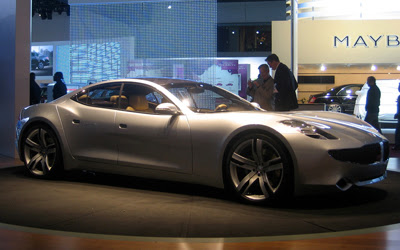
Fisker Karma

Karma pictureThe Fisker Karma represents the future of luxury sports cars. The vehicle has a sporty and attractive design but maintains maximum fuel efficiency. It features a lithium ion battery pack that can power the car for 50 miles before needing fuel. According to Fisker it can go from zero to sixty in 5.8 seconds and reach a top speed of 125 mph.

Images curtosy of AutoBlogGreen.com

Wednesday, January 02, 2008

Q&A About Ford’s Energy Efficient F450

AutoBlogGreen has an interesting Q&A session with Beau Boeckmann, the president of Galpin Auto Sports about the Ford F-450 Super Duty that runs on biodiesel and hydrogen. You can read the transcript of the interview by checking out AutoBlogGreen.


Thursday, December 13, 2007

Land Rover LRX Revealed!

Check out the image below of the new Land Rover LRX. This car is being highly anticipated, and is expected to be unveiled at next month’s Detroit auto show. It has long doors, a sloping roof, 20" wheels, and a 2+2-cabin configuration. For more pictures check out AutoBlog.

Friday, December 07, 2007

New 2010 Mustang Spotted

Spies over at Jalopnik.com spotted Ford performing road tests of what look like the 2010 Ford Mustang. Many of the features seen on the new car reflect the Giugiaro concept car Ford introduced at last year’s LA Auto Show. These features include front and rear fascia and major upgrades to both the interior and exterior. Check out the picture below, or you can view the whole set of pictures at Jalopnik.com.


Monday, November 26, 2007

Honda Hybrid Tax Credit Phase Out

The IRS recently announced that Honda has reached the 60,000 vehicle limit during the calendar quarter ending Sept. 30, 2007. Therefore, the credit for buying any Honda hybrid vehicle begins will begin to phase out beginning January 1, 2008. Vehicles purchased before that date, however, will still qualify for the full credit. For Honda hybrid vehicles bought on or January 1, 2008, the credit is 50 percent of the otherwise allowable credit amount.

The new credit amounts will be as follows:

  • Honda Accord Hybrid AT, Model Year 2007 — $650
  • Honda Accord Hybrid Navi AT, Model Year 2007 — $650
  • Honda Civic Hybrid CVT, Model Year 2007 —$1,050
  • Honda Civic Hybrid CVT, Model Year 2008 — $1,050

Chrysler Releases Sketches Of ecoVoyager Concept

Yesterday Chrysler released sketches of their next concept car, which is expected to be unveiled at the January 2008 Detroit auto show. Check out the sketch below, thanks to Auto Green Blog.


Monday, November 19, 2007

Green Car of the Year: Chevy Tahoe Hybrid

Green Car Journal founder Ron Cogan announced yesterday that this year’s Green Car of the Year Award is the Chevy Tahoe Hybrid. It received the award for demonstrating that a large vehicle with could still offer fuel economy equivalent to that of a much smaller car. Five cars were nominated for this award including the Saturn Aura Green Line, Chevy Malibu Hybrid, Nissan Altima Hybrid and Mazda Tribute Hybrid.

Friday, November 09, 2007

2008 Dodge Viper SRT10 ACR Pictures

Although Dodge’s new Viper SRT10 ACR will not officially be unveiled until the November 13th auto show in Los Angeles, numerous sites have already posted leaked pictures of the impressive new vehicle. It features an 8.4-liter V10 engine with 560 LB-ft of torque. According to Chrysler the car generates 1,000 pounds of down force at 150 mph and can generate 1.5g while cornering. This vehicle is expected to retail for under $100,000. Check out some pictures below, thanks to Jalopnik.


Thursday, October 25, 2007

Porsche to Take Over VW?

Although Porsche has been buying VW stock like crazy for the past year, there has been a piece of legislation called the VW Law which has stopped Porsche from taking full control over the company. However, the European Courts recently stuck down the law and now there is nothing preventing Porsche from increasing their stock ownership. Porsche currently has a 31% stake in VW, but with this new announcement they are expected to increase that to at least 51%. The industry expects Porsche to be patient with the rest of the process, possibly taking up to a year, but there is no doubt that they will soon control VW. Thanks to AutoBlog.

Tuesday, October 16, 2007

New GM Concept Camaro

GM car czar Bob Lutz announced a new Camaro concept car on one of his recent posts on the Fastlane Blog. He describes the new car as being remarkable claims the new Camaro is intended to be "the finest car in its class, ever." Check out a picture of the concept car below, thanks to the GM Fastland Blog.


Monday, October 08, 2007

Nissan Unveils Pivo 2 Concept Car

Nissan unveiled the new Pivo 2 concept car at the Tokio Motor Show a few days ago. The car features a 360-degree rotating cabin, 90-degree turning wheels, and braking and steering drive by wire capabilities. Below is a picture of this funky new concept car, thanks to Engadget.com.

Friday, September 21, 2007

New Video: 650 HP Corvette ZR1

Thanks to Fast Lane Daily I have attached a video of the new 650 HP Corvette ZR1 below. For most of the video the car is just cruising along and you can’t really get a feel for the vehicles power, but at the end there is a nice shot of the car accelerating to get onto a highway. Although a few pictures have been released, this is the first video of the new Corvette which is expected to be unveiled in the January Detroit Auto Show.


Blog Archive